

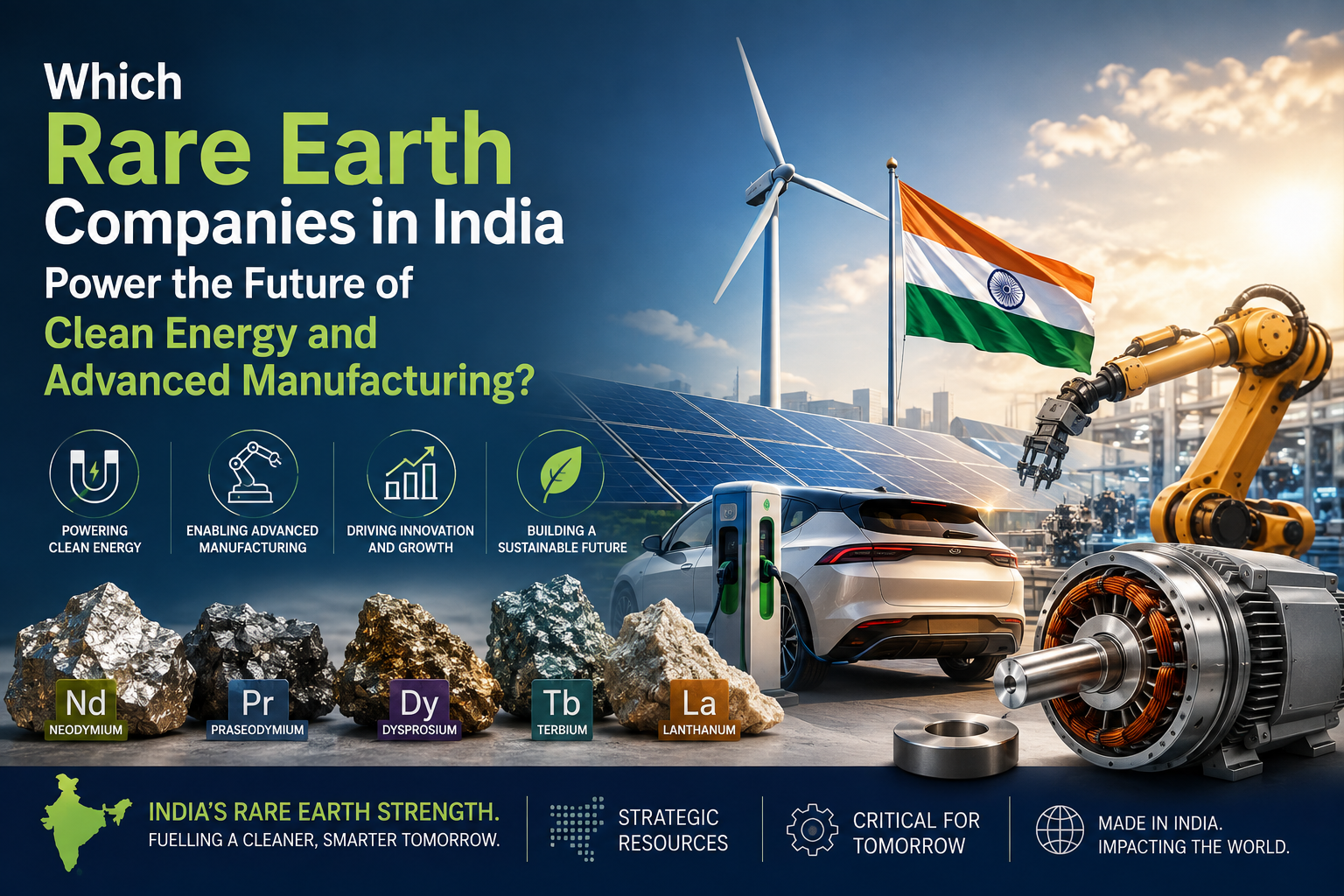
India’s transition toward clean energy, electric vehicles, advanced electronics, and defence manufacturing has increased in recent years. However, behind this transformation is a lesser-discussed but extremely important resource category – rare earth elements (REEs). These minerals are becoming important across the world as they are used for technologies such as EV batteries and motors, wind turbines, semiconductors, smartphones, defence systems, aerospace technologies, etc.
As global supply chains become increasingly uncertain, countries now aggressively focus on securing domestic access to critical minerals and rare earth resources. Among many countries, India also strengthens its long-term strategy to reduce import dependence and build a resilient critical minerals ecosystem.
In this environment, rare earth companies in India are expected to play a major role in supporting industrial growth, energy security, and technological self-reliance.
What Are Rare Earth Elements?
Rare earth elements consist of strategically important minerals used in high-performance technologies. Despite their name, these minerals are not always “rare” in availability, but their extraction, processing, and refining are technologically difficult.
Globally, rare earth supply chains remain highly concentrated, creating concerns around:
- supply security,
- geopolitical risks,
- price volatility,
- and import dependence.
This is why countries including India, the United States, China, Australia, Japan, and members of the European Union are increasingly investing in domestic critical mineral capabilities.
Why Are Rare Earth Minerals Important for India?
India’s long-term economic ambitions depend largely on sectors that require critical minerals and rare earth elements. Even industries like renewable energy, EV manufacturing, power infrastructure, electronics, and defence manufacturing will see a boost in the coming years.
The Government of India has already identified critical minerals as strategically important. They help the nation in achieving long-term industrial and energy goals. Recent policy initiatives, including the National Critical Minerals Mission (NCMM) 2025, and critical mineral block auctions, also highlight strengthening domestic exploration and production capabilities.
Budget 2026 also highlighted the growing importance of rare earth corridors in states like Odisha, Andhra Pradesh, Kerala, and Tamil Nadu to strengthen domestic processing and manufacturing ecosystems.
Leading Rare Earth Companies in India That Drive the Critical Minerals Push
India’s rare earth and critical minerals ecosystem includes both public and private sector players involved in mining, exploration, processing, refining, and advanced materials development.
Vedanta Limited
Vedanta has emerged as one of the key private sector players participating in India’s critical minerals and rare earth ecosystem. It is actively expanding its presence across strategically important minerals, including cobalt, nickel, vanadium, graphite, tungsten, chromium, and rare earth elements. Vedanta and its subsidiaries have secured access to multiple critical mineral blocks auctioned by the Government of India. Of the 55 critical mineral blocks auctioned so far, 34 have been successfully allocated, and Vedanta has secured 10 of them, covering cobalt, rare earth elements (REEs), vanadium, graphite, and potash.
Indeed, the government’s concerted push through the NCMM marks a turning point in harnessing the untapped potential of significant deposits like lithium, vanadium, nickel, and graphite across the Northeast, Chhattisgarh, Rajasthan, and Maharashtra.
The company’s expansion aligns with India’s broader efforts toward resource security, domestic manufacturing, and continued journey toward Aatmanirbhar Bharat.
IREL (India) Limited
IREL is another prominent Indian organisation involved in rare earth processing and mineral extraction. The company primarily works across mineral sands, rare earth compounds, and strategic materials used in high-tech industries.
As India increases its focus on critical minerals, IREL is expected to remain an important contributor to the country’s domestic rare earth ecosystem.
Hindustan Zinc Limited
Hindustan Zinc Limited (HZL), a subsidiary of Vedanta, has also strengthened its focus on critical minerals exploration. The company has secured several mineral blocks containing strategically important resources that may support India’s future clean energy and industrial ambitions.
Coal India Limited
Traditionally known for coal mining, Coal India has also shown interest in critical minerals and strategic resource diversification as India broadens its domestic mineral ecosystem.
Why Investments in Rare Earth Elements Matter the Most?
Rare earth mining and processing require:
- high capital investment,
- advanced technology,
- long exploration timelines,
- and large-scale operational capabilities.
This is why the involvement of rare Earth mineral companies is becoming increasingly important in India’s critical minerals strategy.
Conclusion
The best rare earth companies in India play an important role in building the country’s industrial and technological future. As demand for EVs, renewable energy, semiconductors, electronics, and defence systems increases globally, access to critical minerals and rare earth elements will become strategically essential. India’s growing focus on domestic mining, processing, and manufacturing reflects a larger effort to strengthen resource security and reduce long-term import dependence. Pioneer companies like Vedanta Limited are expanding their critical minerals footprint in alignment with India’s larger economic and industrial ambitions, positioning the country for the next phase of manufacturing and clean energy growth.