

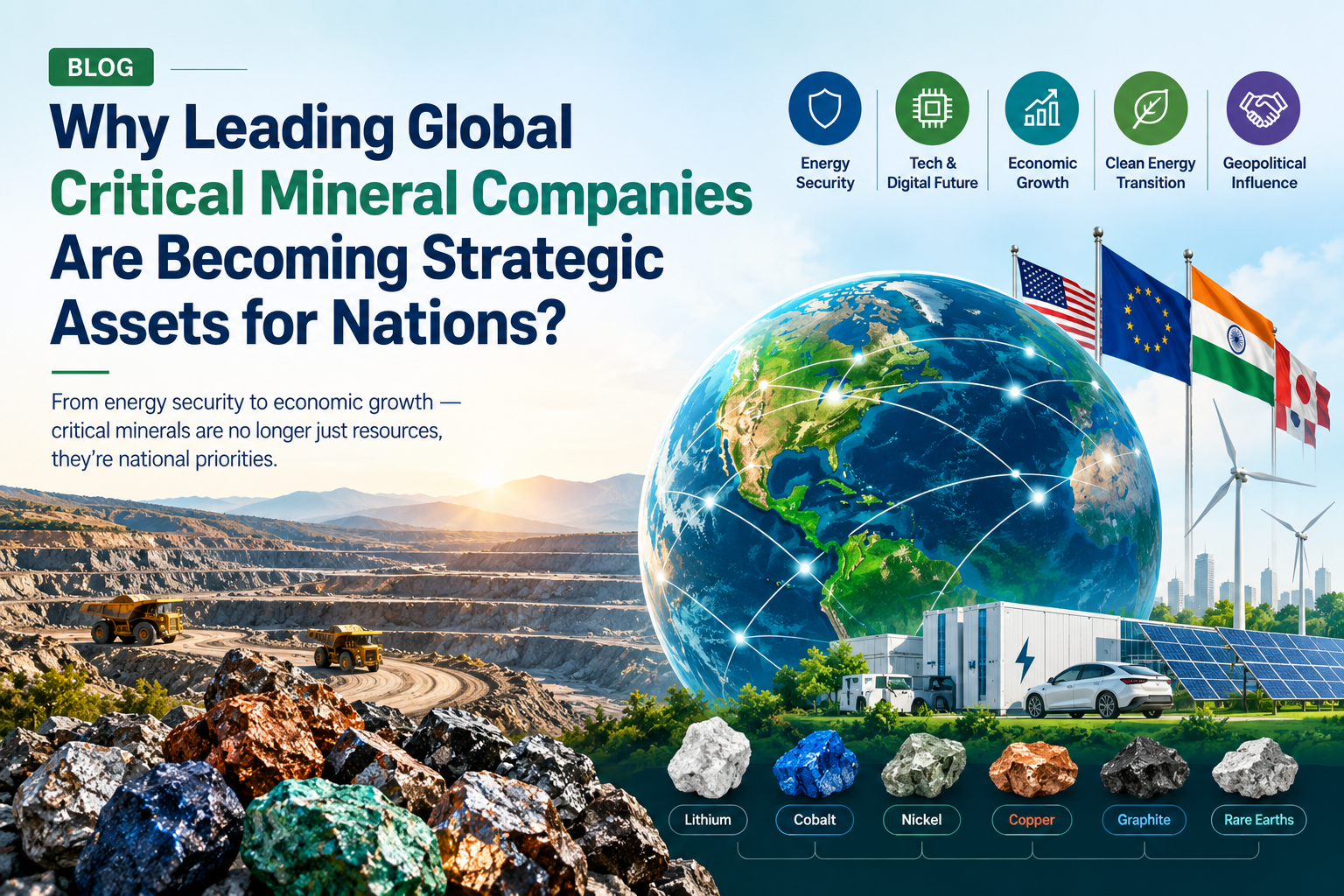
Some decades back, discussions related to economic growth mostly revolved around oil, natural gas, trade routes, and manufacturing capacity. But today, critical minerals have become equally central to discussions around economic security, industrial competitiveness, and the global energy transition. . From being used in electric vehicles and renewable energy to semiconductors, defence equipment, and advanced manufacturing, critical minerals have become the pillar of every modern industry.
Thus, leading global critical mineral companies are not considered as ordinary mining businesses; rather are being recognised as strategic assets that help nations secure economic growth, industrial expansion, and long-term competitiveness.
The New Race for Minerals
Earlier, the nations across the world competed to get fossil fuels as energy security depended on oil and gas supplies. Though traditional energy still remains important, the global economy is foraying into a phase where minerals are considered equally important.
- Every modern industry depends on metals and minerals.
- Copper supports electrification.
- Aluminium makes lightweight transportation and infrastructure possible.
- Zinc protects bridges, railways, and industrial assets from corrosion.
- Lithium, nickel, and cobalt support battery manufacturing.
- Rare earth elements power advanced electronics and high-performance motors.
Needless to say, without these materials, most of the technologies shaping the future cannot be manufactured at scale .
This growing dependence clearly explains why leading global critical mineral companies have become strategically important to governments and industries alike. .
Why Investors Give More Attention to Resource Companies?
In recent years, investors’ interest in critical mineral producers has grown significantly, driven by surging global infrastructure investments, urbanisation, digitalisation, and electrification. All these factors, together, are expected to increase consumption of key minerals over the coming decades.
However, at the same time, deploying new mining projects takes years of exploration, environmental approvals, infrastructure development, and capital investment, thereby increasing the demand-supply gap.
According to global investors, companies with established operations, proven reserves, and strong production capabilities are better positioned to benefit the most from long-term demand growth.
Role Played by Diversified Resource Companies
Not all critical mineral companies operate in the same way. Many companies are specialised in a single mineral, while others maintain diversified portfolios across multiple commodities. Diversified companies like Vedanta Limited, BHP, Indian Rare Earths Limited (IREL), and Rio Tinto often enjoy greater operational flexibility as they are exposed to several industries and market cycles simultaneously.
Vedanta, through its presence in zinc, aluminium, oil and gas, iron ore & Steel, power, and other resource segments, makes a significant contribution to multiple areas of industrial development. Metals such as zinc and aluminium continue to play important roles in infrastructure creation, transportation systems, manufacturing growth, and electrification projects.
Through a diversified approach, resource companies like Vedanta can support a broader range of economic activities while creating resilience against fluctuations in individual commodity markets.
How Will Critical Minerals Shape the Next Decade?
With fast-evolving technology, the demand for critical minerals will expand across multiple sectors, with electric vehicles, one of the main factors, contributing to the surging demand. Beyond this, some other factors that are expected to boost the demand for critical minerals in the future are:
- Smart cities
- Data centres
- Industrial automation
- Grid modernisation projects
- Aerospace manufacturing
- Defence technologies
- Telecommunications infrastructure
Each of these sectors requires significant quantities of metals and minerals, which eventually will push the leading critical mineral companies in the world to boost their operations.
This means the importance of Leading Global Critical Mineral Companies will continue to grow regardless of short-term market cycles.
Their contribution extends beyond supplying raw materials. They help support industrial development, strengthen supply chains, create employment opportunities, and enable technological progress.
Conclusion
Needless to say, the top critical mineral companies in the world are evolving rapidly. They are no longer viewed solely as producers of raw materials; rather have become an important enabler of industrial growth, manufacturing competitiveness, technological advancement, and national economic resilience.
As governments focus on resource security and industries seek dependable supply chains, companies operating in the critical minerals sector will remain central to global development strategies.
In a country like India, which is focused on strengthening its domestic access to critical minerals, companies like Vedanta will continue to be trendsetters.