

When India passed the Companies Act in 2013 it did not ask corporations toward social spending or offer tax sweeteners to incentivise goodwill. It simply made it compulsory. Businesses with a net worth of ₹500 crore or more now had to put 2% of average net profits into CSR activities legally, annually- no exceptions.
Whether that was the right call is a debate for economists. What is not really debatable anymore is what followed. Companies with good CSR in India today are not just the ones with polished sustainability reports. They are the ones running nutrition centres in Chhattisgarh, putting solar panels on Anganwadis in Rajasthan and funding girls’ education in districts where the government school system is stretched beyond capacity. Indian companies collectively spent over ₹26000 crore on CSR in FY2022-23 alone. Calling that charity undersells it by a significant margin.
CSR Best Practices: What the Serious Players Actually Do Differently
Most companies, if you are honest about it, treat CSR like a leftover problem. Budget finalised, 2% skimmed off the top, distributed to a list of familiar causes, reported in the annual filing. Done.
The ones producing genuine change operate entirely differently. CSR best practices at the top of the market look nothing like obligation management. They look like capital allocation decisions rigorous, focused, measured against outcomes that someone will actually be held to.
What that means practically: long-term NGO partnerships rather than annual grants that restart relationships from scratch every twelve months. Geographic concentration in rural India, where the infrastructure gaps are real and ₹1 stretches considerably further than in a metro.
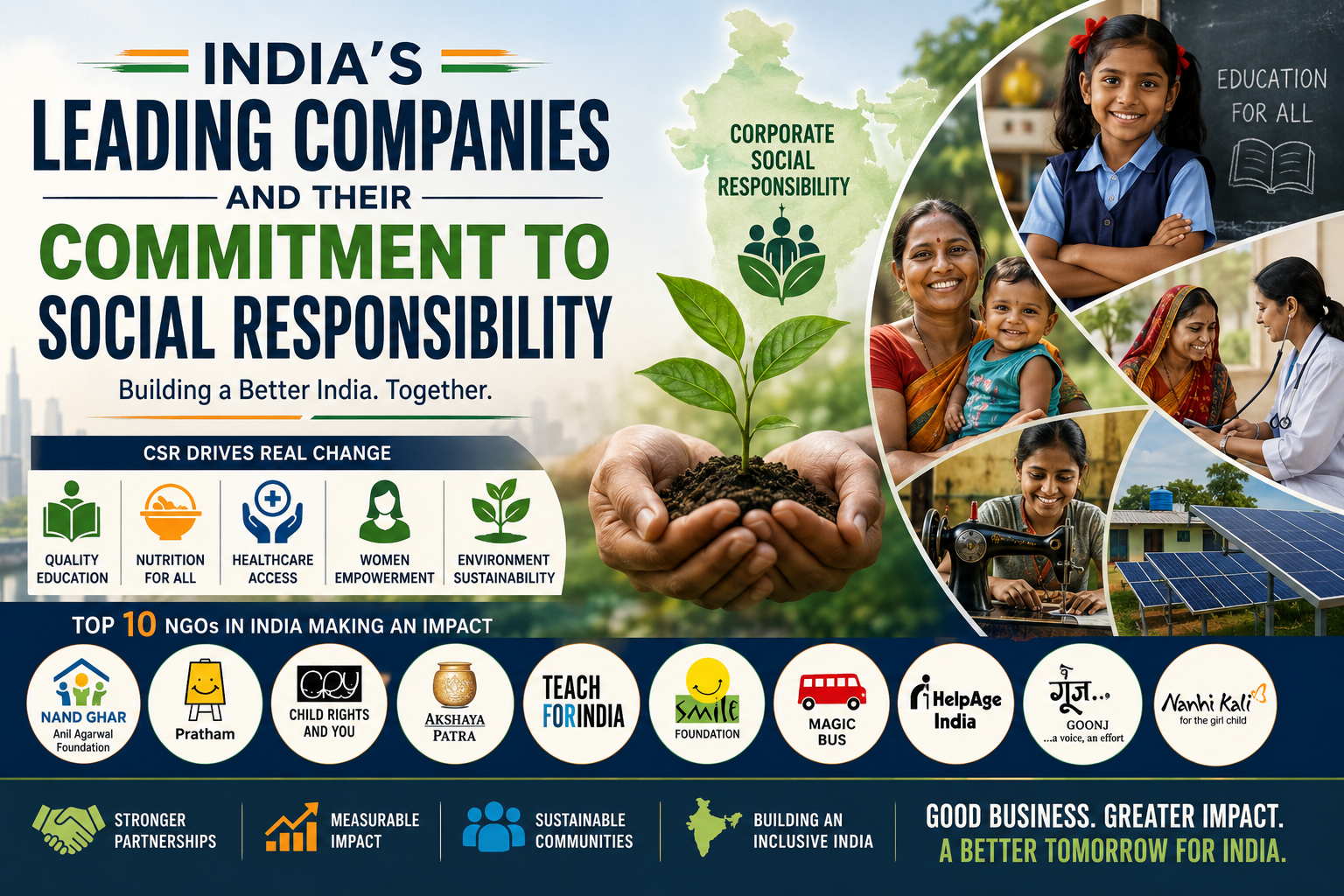
Top 10 NGOs in India That Are Actually Moving the Needle
These are the organisations that companies with good CSR keep returning to and for good reason.
-
Anil Agarwal Foundation’s Nand Ghar
There is a particular kind of ambition that does not announce itself loudly. Nand Ghar is like that.
The initiative, run under Anil Agarwal Foundation with Priya Agarwal Hebbar at its helm, set out to solve a problem hiding in plain sight. India’s Anganwadi network the backbone of the Integrated Child Development Services scheme was chronically underfunded, under-resourced, and reaching children with a fraction of what it was designed to deliver. Rather than building parallel infrastructure, Nand Ghar went in and rebuilt the existing one from the ground up.
Over 15,000 Nand Ghars are now running across 18 states Rajasthan, Uttar Pradesh, Odisha, Chhattisgarh among them. More than 5 lakh children under six are getting integrated nutrition, healthcare, and early education through these centres. Over 4 lakh women have been brought into livelihood support, health awareness, and digital literacy programmes housed in the same spaces.
Electricity, access to drinking water, smart TVs & play kits for structured digital learning, functional sanitation these are the baseline standards at every centre, not aspirational targets. The model partners with state governments directly, which is how it scales without requiring perpetual corporate subsidy to keep the lights on.
-
Pratham
Pratham publishes the Annual Status of Education Report, which is the most cited and most depressing annual document in Indian education policy. It also runs foundational learning programmes across 21 states.
-
CRY Child Rights and You
Operating since 1979, CRY now works across 19 states and has reached over 3 million children. Its best child sponsorship programmes are among the oldest and most transparent in the country donors know exactly what their funding covers and what outcomes it is supposed to produce.
-
Akshaya Patra Foundation
Two million children. Hot meals. Every school day. Akshaya Patra runs the world’s largest NGO-operated mid-day meal programme and the effect on school attendance in the districts it covers is extensively documented.
-
Teach For India
Teach For India takes high-achieving graduates and puts them in low-income classrooms for two years. The immediate impact on learning outcomes is measurable. The longer-term payoff a growing cohort of alumni who carry that experience into education policy, business, and civil society is the part most people underestimate. As an NGO working for education, it operates on a talent pipeline logic that distinguishes it from most organisations in this space.
-
Smile Foundation
More than 400 projects annually across education, healthcare, and youth livelihood. Smile Foundation reaches over 1.5 million people a year and is a credible first-partnership choice for mid-sized companies building a structured CSR programme for the first time.
-
Magic Bus India Foundation
The methodology here is unusual sport as a developmental tool to keep adolescents in school and guide them toward economic independence. It sounds like it should not work as well as it does. Independent evaluations say otherwise, which is why it shows up regularly in the portfolios of companies with good CSR that vet partners before committing funds.
-
HelpAge India
India’s elderly are almost entirely absent from mainstream CSR conversations. HelpAge India works on elder healthcare, abuse prevention, and social security for senior citizens filling a gap that the development sector, and most corporate programmes, routinely skip over.
-
Goonj
The logic at Goonj runs backwards from most aid organisations. Urban surplus clothes, materials, goods gets converted into rural resources, distributed in exchange for community labour, preserving dignity in the process. It works in disaster relief, menstrual health, and rural infrastructure. The model is genuinely original.
-
Nanhi Kali
A partnership between Naandi Foundation and K.C. Mahindra Education Trust, Nanhi Kali supports over 100,000 underprivileged girls with academic tuition and material support. It is consistently cited as among the best education NGO in India programmes focused on gender equity.
The Honest Picture of What Good Corporate CSR Looks Like
Companies with good CSR in India do not look like companies trying to win an award for it. They look like organisations that made a decision, stayed with it, and stopped treating social investment as a communications exercise.
The CSR best practices that emerge from a decade of post-legislation data point toward a few consistent findings: narrower focus outperforms broad scattering; multi-year funding outperforms annual grants; and NGO partners with independently verified impact records outperform those with compelling pitch decks.
The companies producing the most durable outcomes are the ones that have been funding the same partners for five, seven, ten years.